I have been thinking about the content of my last post which discussed how social media data will change how small business runs. (See previous Blogpost) link here The reason? With increase technology that is happening around us, there will clearly be efficiencies in how things get done, but there will also be changes to how we interact as business professionals. The advent of social media is about create tons of key content, connecting people more effortlessly, and giving you key modalities to share information. While this is all very good and interesting, the rise of nanocapitalism in my opinion finds its foundation in something much deeper.
In my previous corporate lives, I spent the majority of my time working to help large organizations find reasons to do things they didn't want to do. Whether I was working in the lab developing toilet bowl cleaners, managing partnerships at a high level to connect people who needed technology or simply finding new ideas that could be applied to the business to create ROI, the core of those efforts was about people, culture and change. So while all the tools and methods involved in social media create astounding ways to communicate, tools are just that tools. They are merely a means to an end.
Are they powerful? Absolutely! Why? Because as I often write here, with my companies' product, I am able to learn about the consumer behavior on just about any topic in a very short period of time for little to no money from my dining room table (literally). NetBase has an offering that is changing the way you filter and understand social media data. What I see countless times within customers is always the same. It is about people, it is about application of that technology and almost always it is about cultural change. You can sell anything to anyone (insert ice to eskimos analogy here!) but once they have the tools you need to help them see how it fits the structure.
This brings me back to my point (sorry for rambling a bit). Nanocapitalism is a concept that is about the application of tools to a process of doing business that can lead to a "new world order". And from a competitive perspective, changes to the landscape mean changes in who is successful. We say giants can't fail. I believe one day the rise and fall of groupon will be a great case study, but that is for another day.
Nanocapitalism my friends is not only going to be about the efficiency created by new tools. It is not only going to be about the costs you can save in your business. It is about the corporate culture of one. It is about the confidence it will bring to the small business owner to focus on what they are good at and not feel compelled to hire others in a formal way to run things. The cross section of great technology, connectivity and small business corporate culture to create an acceleration of what's possible to achieve.
I will use dear sister as an example of the rise of nanocapitalism. Her efforts as a sole proprietor in her photography business is what I consider the perfect example of someone who is going to kick some serious tail in a nanocapitalistic society. Let's start with her website (link here). You go there and see a great example of her storefront. Anyone can do this. She has done a great job of giving you insight in to how she runs her shop. Her photos will strike you as different (she shoots tons of weddings, people, food and I guess whatever). Next, Let's take a look at her ability to market herself online (2nd generation of ecommerce) (her facebook page). Again, beyond her storefront, she has done a great job of "sharing" her work with others. She also has a blog (blog link here). Again, she canvasses using freely avaiable tools to connect you not only with the images she shoots but also enable references on facebook to "like" her and through her blog gives perspective on what she is shooting and why. My sister is a great example of a small business owner who is leveraging social media to build her brand. She is missing doing market research on her very craft however (tee hee...her brothers' job and passion).
Most would say, wow, that is nanocapitalism. Look at the small proprietor building her business using social media tools. In my opinon, it is not. I grew up with my sister (duh). One of the reasons she has always been an inspiration to me and someone who has taught me much about how to embrace differences in people's path in life is because of her ability to leverage her strengths (like we all have) to get where she is today. She is a potential model for nanocapitalism because of the things she is doing that are not mentioned above.
She hires no marketer because she has the tools. She is constantly mentioning new social apps to me like pinster that are driving connectivity between what people want to what she has. No market research needed. She shared with me the tools she is implementing to connect to her bookkeeper who works for her on a part time basis. She is part of a network of expert photographers that "validate" her work because she is part of the group. She partners with other photographers to round out her resource needs in running her business. The list goes on an on.
She is a nanocapitalist because the tools are giving her the confidence and path to have a networked corporate culture. I always tell her she has two paths towards expansion: bring in more people or do such a great job she can charge a hell of a lot more for what she does. I often believe to leverage her own skills the second would be better. Nanocapitalism gives her the choice. Why? Because the second path is possible because that method can be attained with the help of the tools she uses. When her business gets too big for her to take the time she can find other "experts" to spend a portion of their time helping her. She can "partner" for pieces of their time to build her brand bigger without taking on any overhead whatsoever. And thus her corporate culture can play to her strengths and desires and give her options. Hell, people can pay her for a piece of her time.
Imagine a time when her blog writer who she pays a small fraction to do work knows of a bloggers conference (I made it up) that needs a photographer for two days. Because her marketing efforts have allowed to focus on creatively building her expertise and brand she may get that opportunity and be able to charge 3X versus if she spent all her time having to be the expert. But wait there's more! Because she uses nanocapitalistic principles, her ROI on this work is 50% higher because her overhead will be lower.
This process could help the US win in its innovation effort because the free market is getting flipped on its head. Gone will be the days that size and scale are needed to really grow a business. Is it better to have your own business that has $50 million in sales with a 10% profit margin or a business that has $10million in sales with an 50% profit margin. Oh yeah, the $50 million dollar company has 50 people working for it, while the $10 million has 3. The point is this...small businesses are going to get the opportunity to think about the American dream differently. We are all overworked, overtired, and in my opinion OVERCORPORATE CULTURED to death. To have control, make the same and perhaps have more time for yourself is becoming the American dream.
Social media has shifted the balance of power from B2C to C2B. The consumers have the power and are taking it back from the corporations. In the coming years, I predict that new brands will not be made but purchased because it is cheaper to Buy than Make. The second is people's financial gain could grow if they can leverage others with technology as a means to enable it to increase their profit margins. The term MEO can move from a narcissistic statement about our own need to be heard and into a place that means I run my business with quiet confidence.
And my sister...she has the frustrating tendency to take the predictions or advice I give her as I have for years about how great she is and why her decisions are so good and attribute to someone else later.
I figured I would go on record publicly to predict this. She is a model of nanocapitalism and her desire to maintain control of how she does things AND leverage others to scale her business in a smart way will lead to a day where her ability to do the same work for higher fees is the reason she will succeed. Her mindset is the model of small business and her ability to conquer the fears many of us have in starting are own thing is something that requires some thought.
I just hope she doesn't charge her brother too much to get a better headshot.
Wednesday, February 15, 2012


Sunday, February 12, 2012
Social media and the rise of NANOCAPITALISM
What the hell does microcapitalism mean? I guess it is a fancy way to say small business development, but I call it that for several reasons. Below is a definition I got off the internet.
"Microcapitalism, an idea that capital should not only be in the hands of private citizens, but in the hands of as many private citizens as possible. Seth Godin has published several books an articles on this, including Small is the New Big. Microcapitalism is, in fact, an old idea. The idea that the village blacksmith, the family farm, and the general store owner should own their business, the land their business sat on, and take full responsibility for their production and income are as old as civilization itself." (http://www.examiner.com/church-state-in-grand-rapids/microcapitalism-the-economics-of-small-business)
To me this is just saying that microcapitalism is about small business and having your own business that you control. It does not discuss how you form, build and execute your business. This concept seems redundant in the current permutation of the business landscape. It does not take into account the manner in which the future of business will run or in some cases already running.
I would submit that with maturation of e-business and the advent of the market research age of e-commerce (as I like to call it the 3rd generation of e-commerce...generation 1 was the storefront, generation 1A was the backbone of the storefront, and generation is the marketing age of social media sites), one can begin to view to future of microcapitalism...nanocapitalism.
What is the difference? Nanocapitalism takes a small business and breaks into even smaller pieces. The aforementioned view of microcapitalism suggests that individual owners own their business. It assumes that people will put the brick and mortar in place they need to run the business. Tangible assets that report to the leader of a business with a goal of generating revenue and control for the owner and their partners. Those who work for the small business are still employees.
Nanocapitalism's foundation is based on a more networked model of running a business. My good friend Cindy McCann owns her own business called customer performance solutions. Her business is based on providing customized training and consulting to help educate the workforce efficiently and effectively. She has worked with me providing 3rd party support for an education strategy I own. She is my partner and although she does not work for my company, she works along side me as if she does. What makes her business a nanocapitalistic model? She can bring ANY resources to bear to solve our issues on an AS NEEDED BASIS. If I need video...she is connected to another small business owner who she can charge us for to use on an as-needed basis.
She only carries the resources she needs when she needs them to provide the services her clients needs. It is a network business model that helps ALL microcapitalist owner function and OWN what they kill so to speak. So big whup...this is just a networked business model.
I have written before about why the dot com bubble won't happen again and it has to do with evolution of ecommerce. Social media as stated above is the 3rd generation of ecommerce. The marketing of individuals (trying to be their own brand and nanocapitalists in their own right) are now generating the content to allow businesses to study the marketplace.
Over time we are already seeing the 4th generation of ecommerce coalescing. It will be the advent of sourcing talent. And I don't simply mean sourcing microtask workers...we are talking about expert talent. As the concept of crowdsourcing works its way through the value chain we can imaging our ability to find people in the social media sphere will actually become the vehicle to enable businesses to run themselves with little to no infrastructure.
In the future, I could source all parts needed to create a business; my virtual storefront (1st generation ecommerce), my marketing efforts (2nd generation ecommerce ala facebook/twitter or other not yet seen products), study my market (3rd generation ecommerce...social media analytics) and finally source my company's talent to run it (4th generation ecommerce...the talent pool). In this future state we will all be microcapitalists connected through the nanocaptialist network of talent.
As Cindy says, not a moment before they are ready. Are you ready to think about your entire business as being yourself sitting in a room with a phone and computer running what could be a vast network of people getting the right things done at the right time. I guess we will need to have better ways to connect that talent to monitor its way of doing things.
The fun is just beginning it is a matter of time before the size of companies shrinks because you can own your culture, your methods and your time at a higher profit margin that carrying overhead that you don't need. You will be providing service as a small part of a vast network and thus the rise of nanocaptialism begins...
As it pertains to the cross section of small business and technology some might say that small companies who are technology saavy would fit into the concept that HOW they do business is microcapitalism. If this were true however, the way the provide value to their customers/consumers would be fragmented.
So what am I getting at when I mention the term microcapitalism.
"Microcapitalism, an idea that capital should not only be in the hands of private citizens, but in the hands of as many private citizens as possible. Seth Godin has published several books an articles on this, including Small is the New Big. Microcapitalism is, in fact, an old idea. The idea that the village blacksmith, the family farm, and the general store owner should own their business, the land their business sat on, and take full responsibility for their production and income are as old as civilization itself." (http://www.examiner.com/church-state-in-grand-rapids/microcapitalism-the-economics-of-small-business)
To me this is just saying that microcapitalism is about small business and having your own business that you control. It does not discuss how you form, build and execute your business. This concept seems redundant in the current permutation of the business landscape. It does not take into account the manner in which the future of business will run or in some cases already running.
I would submit that with maturation of e-business and the advent of the market research age of e-commerce (as I like to call it the 3rd generation of e-commerce...generation 1 was the storefront, generation 1A was the backbone of the storefront, and generation is the marketing age of social media sites), one can begin to view to future of microcapitalism...nanocapitalism.
What is the difference? Nanocapitalism takes a small business and breaks into even smaller pieces. The aforementioned view of microcapitalism suggests that individual owners own their business. It assumes that people will put the brick and mortar in place they need to run the business. Tangible assets that report to the leader of a business with a goal of generating revenue and control for the owner and their partners. Those who work for the small business are still employees.
Nanocapitalism's foundation is based on a more networked model of running a business. My good friend Cindy McCann owns her own business called customer performance solutions. Her business is based on providing customized training and consulting to help educate the workforce efficiently and effectively. She has worked with me providing 3rd party support for an education strategy I own. She is my partner and although she does not work for my company, she works along side me as if she does. What makes her business a nanocapitalistic model? She can bring ANY resources to bear to solve our issues on an AS NEEDED BASIS. If I need video...she is connected to another small business owner who she can charge us for to use on an as-needed basis.
She only carries the resources she needs when she needs them to provide the services her clients needs. It is a network business model that helps ALL microcapitalist owner function and OWN what they kill so to speak. So big whup...this is just a networked business model.
I have written before about why the dot com bubble won't happen again and it has to do with evolution of ecommerce. Social media as stated above is the 3rd generation of ecommerce. The marketing of individuals (trying to be their own brand and nanocapitalists in their own right) are now generating the content to allow businesses to study the marketplace.
Over time we are already seeing the 4th generation of ecommerce coalescing. It will be the advent of sourcing talent. And I don't simply mean sourcing microtask workers...we are talking about expert talent. As the concept of crowdsourcing works its way through the value chain we can imaging our ability to find people in the social media sphere will actually become the vehicle to enable businesses to run themselves with little to no infrastructure.
In the future, I could source all parts needed to create a business; my virtual storefront (1st generation ecommerce), my marketing efforts (2nd generation ecommerce ala facebook/twitter or other not yet seen products), study my market (3rd generation ecommerce...social media analytics) and finally source my company's talent to run it (4th generation ecommerce...the talent pool). In this future state we will all be microcapitalists connected through the nanocaptialist network of talent.
As Cindy says, not a moment before they are ready. Are you ready to think about your entire business as being yourself sitting in a room with a phone and computer running what could be a vast network of people getting the right things done at the right time. I guess we will need to have better ways to connect that talent to monitor its way of doing things.
The fun is just beginning it is a matter of time before the size of companies shrinks because you can own your culture, your methods and your time at a higher profit margin that carrying overhead that you don't need. You will be providing service as a small part of a vast network and thus the rise of nanocaptialism begins...
As it pertains to the cross section of small business and technology some might say that small companies who are technology saavy would fit into the concept that HOW they do business is microcapitalism. If this were true however, the way the provide value to their customers/consumers would be fragmented.
So what am I getting at when I mention the term microcapitalism.
Wednesday, February 8, 2012
Election 2012 - Who can resist social media meets politics????
During the fall, I spent some time looking at the Republican political field (link here)as well as President Obama (Link 1 here, Link 2 here). While there have been a hundred debates already on the Republican side and even some controversy around that Chrysler Ad during the Superbowl, the reality is we are really getting into the thick of the political season. And whether you are a Republican or a Democrat the thought of how social media analytics is going to impact this election is exhilarating. Which ever candidate can tap the power of what people are saying and how they can make adjustments to their strategies is going to have a huge advantage in the coming election. There is so much proof of how social media commentary can impact things. As I wrote the other day, I was amazed when doing some novel prototyping of new social media methods, how impactful these methods can be. In fact, I was visiting customer looking at some historical data around some business analysis and we were all shocked to dimensionalize how social media could have impacted how they dealt with issue. We literally all learned something about their strategy and the social media reality of the situation. It was almost shocking.
As I always say when it comes to social media analysis, it is the wild west (link here), but it is changing in 2012 . Everyone is realizing the social media sun is coming up and there is so much room to grow (link here). As for the political climate, I decided to take a wholesale look at the last 5 candidates using brand passion and little funky dance with the data. For this data pull, I created a brand passion index around two key data points. I took each candidates' data for the full year from 2/8/11 to 2/8/12. And since the election is in 2012, I pulled the data since the 1st of the year to give a sense of comparison.

This brand passion index is getting pretty fascinating to me. If you looked at my previous posts, you will see some interesting things. For one...President Obama is slowly improving his brand passion. while he does have the most negative sentiment overall, he is showing some significant movement in since year began. What is most amazing about this is the sheer volume of data that he generates. Moving the titanic is difficult and the good news for President Obama is his is moving in the right direction...upward.
As for the Republican field, it really is sort of a mess. With the pummeling the President has taken since the 2010 elections, any movement at all is welcome. As for the Republican field, however, they all live in a better world of sentiment, but boy do people lack passion for them all. Good, bad or otherwise President Obama generates more passion than all of them by a long shot. If you think about what is going in the race for the nomination we see decent correlation with all the things being said.
Mitt Romney continues to languish in the neutrality land of mediocre passion. And if you look at past posts on the subject he really is dead stuck where he has been versus every analysis I have done. He may have the most buzz of the candidates (a good thing), but he can get ahead.
Newt Gingrich...it is true that he had a brilliant flash forward, but he has peaked and is slowly diving down. His reality is this...it looks like has not broken out as he thought. He merely caused a rucus that seems to be dying (much like our friend Herman Cain) (link here).
As for Santorum; even though is the darling that last few days, I would say that his overall buzz and position are good, but not great. He trails all candidates in buzz, which means that he is not dominating the discussion as much as a real threat should. They say too little too late...I agree.
And Ron Paul...he does have the most passion an strongest sentiment. I would even argue he is in the best position of everyone. Those who like him...really do. The problem he faces is this it seems like a passionate niche following. I would say this, however, he is a real threat to the Republicans is he is a 3rd party candidate. He could easily throw the balance of the election by pulling 3-4% of the vote should he run.
But lets take a different look at this data. Below is a chart that shows the raw data that makes up this chart. We will see their Buzz, Sentiment and Passion for the two periods discussed. But I added another column. To get a sense of "momentum" I also calculated what percentage of their buzz in 2012 represents the total. It seems like an interesting way to look at their momentum going forward. And I believe the results are interesting to say the least.

Looking at the momentum column you will see little surprise that President Obama's buzz since the beginning of the year is the lowest. He generates so many sound bites and is in the news for so many reasons the buzz since the beginning of the year is proportional. That being said to see a 7 point jump in his sentiment versus the last year is pretty amazing. That is a big jump in the last 5 weeks. It is real. The economic news they say bodes well for him. These number suggest that is true.
The next number worth noting is Rick Santorum's. It is amazing to see that the amount of buzz he generates as a percentage over the past year is almost 66%. While his buzz is lower, this change in momentum means to me that there real discussion going on about him. It is almost as if the Republicans are trying to figure out what to do. It will be interesting to watch how this "momentum" changes. It will cool to watch if we keep calculating this number going forward if it goes up or down. The conversation is real but will it amount to anything.
On the flip side, our potential spoiler Ron Paul is seeing the opposite trend. He may have the best position in the brand passion index, but his momentum is starting to wane as are most of his polling numbers. The discussion for him a s serious candidate is waning but those who talk about him love him as we all already know. Watch out gang...if his brand passion maintains you are looking at very interesting situation should he run as a 3rd party.
As for Mitt Romney and Newt Gingrich. They are deadlocked in the middle on momentum. Both of them have generated 45% of their buzz since the beginning of the year. Boy are they simply floating along. Neither of them seizing position against everyone else.
What we see here is what we hear. Candidates are trading positions rapidly. One would expect that Mitt Romney should have a higher "momentum" in his buzz, but alas even with the most buzz his acceleration is lower that Rick Santorum.
What does this all mean. Not sure, but I do believe we may have uncovered another metric in social media we can track and watch going forward. The concept of social media momentum may be a very telling sign of things to come as the year wears on.
It will be interesting to watch the following
1. Once the Repuclican Field picks its candidate will we see a major climb in the President's "momentum? For now there is little need to discuss him politically as the fight is going on somewhere else.
2. Will future Romney wins correlate to greater momentum for his candidacy? He is generating the buzz, but he lives in a sad part of the Brand Passion Index AND he has less momentum in the discussion. That needs to change.
3. Can Santorum continue his astonishing momentum or will the vetting he is going slam into going to affect it? He has the attention of everyone after the other night. That could be good or bad. When Rick Perry had it...he nose dived. When Herman Cain had it, he did too. Newt Gingrich...same thing. No one has stood up to Romney effectively, but we shall see.
Boy politics is fun regardless of your affiliation. I find watching it unfold and linking it to social media is a great way to take over the wild west...
As I always say when it comes to social media analysis, it is the wild west (link here), but it is changing in 2012 . Everyone is realizing the social media sun is coming up and there is so much room to grow (link here). As for the political climate, I decided to take a wholesale look at the last 5 candidates using brand passion and little funky dance with the data. For this data pull, I created a brand passion index around two key data points. I took each candidates' data for the full year from 2/8/11 to 2/8/12. And since the election is in 2012, I pulled the data since the 1st of the year to give a sense of comparison.

This brand passion index is getting pretty fascinating to me. If you looked at my previous posts, you will see some interesting things. For one...President Obama is slowly improving his brand passion. while he does have the most negative sentiment overall, he is showing some significant movement in since year began. What is most amazing about this is the sheer volume of data that he generates. Moving the titanic is difficult and the good news for President Obama is his is moving in the right direction...upward.
As for the Republican field, it really is sort of a mess. With the pummeling the President has taken since the 2010 elections, any movement at all is welcome. As for the Republican field, however, they all live in a better world of sentiment, but boy do people lack passion for them all. Good, bad or otherwise President Obama generates more passion than all of them by a long shot. If you think about what is going in the race for the nomination we see decent correlation with all the things being said.
Mitt Romney continues to languish in the neutrality land of mediocre passion. And if you look at past posts on the subject he really is dead stuck where he has been versus every analysis I have done. He may have the most buzz of the candidates (a good thing), but he can get ahead.
Newt Gingrich...it is true that he had a brilliant flash forward, but he has peaked and is slowly diving down. His reality is this...it looks like has not broken out as he thought. He merely caused a rucus that seems to be dying (much like our friend Herman Cain) (link here).
As for Santorum; even though is the darling that last few days, I would say that his overall buzz and position are good, but not great. He trails all candidates in buzz, which means that he is not dominating the discussion as much as a real threat should. They say too little too late...I agree.
And Ron Paul...he does have the most passion an strongest sentiment. I would even argue he is in the best position of everyone. Those who like him...really do. The problem he faces is this it seems like a passionate niche following. I would say this, however, he is a real threat to the Republicans is he is a 3rd party candidate. He could easily throw the balance of the election by pulling 3-4% of the vote should he run.
But lets take a different look at this data. Below is a chart that shows the raw data that makes up this chart. We will see their Buzz, Sentiment and Passion for the two periods discussed. But I added another column. To get a sense of "momentum" I also calculated what percentage of their buzz in 2012 represents the total. It seems like an interesting way to look at their momentum going forward. And I believe the results are interesting to say the least.

Looking at the momentum column you will see little surprise that President Obama's buzz since the beginning of the year is the lowest. He generates so many sound bites and is in the news for so many reasons the buzz since the beginning of the year is proportional. That being said to see a 7 point jump in his sentiment versus the last year is pretty amazing. That is a big jump in the last 5 weeks. It is real. The economic news they say bodes well for him. These number suggest that is true.
The next number worth noting is Rick Santorum's. It is amazing to see that the amount of buzz he generates as a percentage over the past year is almost 66%. While his buzz is lower, this change in momentum means to me that there real discussion going on about him. It is almost as if the Republicans are trying to figure out what to do. It will be interesting to watch how this "momentum" changes. It will cool to watch if we keep calculating this number going forward if it goes up or down. The conversation is real but will it amount to anything.
On the flip side, our potential spoiler Ron Paul is seeing the opposite trend. He may have the best position in the brand passion index, but his momentum is starting to wane as are most of his polling numbers. The discussion for him a s serious candidate is waning but those who talk about him love him as we all already know. Watch out gang...if his brand passion maintains you are looking at very interesting situation should he run as a 3rd party.
As for Mitt Romney and Newt Gingrich. They are deadlocked in the middle on momentum. Both of them have generated 45% of their buzz since the beginning of the year. Boy are they simply floating along. Neither of them seizing position against everyone else.
What we see here is what we hear. Candidates are trading positions rapidly. One would expect that Mitt Romney should have a higher "momentum" in his buzz, but alas even with the most buzz his acceleration is lower that Rick Santorum.
What does this all mean. Not sure, but I do believe we may have uncovered another metric in social media we can track and watch going forward. The concept of social media momentum may be a very telling sign of things to come as the year wears on.
It will be interesting to watch the following
1. Once the Repuclican Field picks its candidate will we see a major climb in the President's "momentum? For now there is little need to discuss him politically as the fight is going on somewhere else.
2. Will future Romney wins correlate to greater momentum for his candidacy? He is generating the buzz, but he lives in a sad part of the Brand Passion Index AND he has less momentum in the discussion. That needs to change.
3. Can Santorum continue his astonishing momentum or will the vetting he is going slam into going to affect it? He has the attention of everyone after the other night. That could be good or bad. When Rick Perry had it...he nose dived. When Herman Cain had it, he did too. Newt Gingrich...same thing. No one has stood up to Romney effectively, but we shall see.
Boy politics is fun regardless of your affiliation. I find watching it unfold and linking it to social media is a great way to take over the wild west...
Sunday, February 5, 2012
Social Media Fatigue is a Relativity Thing
I have been reading a lot about the concept of social media fatigue. This idea which simply states that people are totally worn out from the cacophony of engaging with each other over a virtual world. In fact, I read an article on Yahoo! about a guy who totally unplugged from all things social: email, facebook, twitter, even his cell phone. I found the article interesting (link here) because I remember a time when I had none of these accessories. In fact, I often benchmark social history for some strange reason with the movie Less than Zero because I remember these raucous 20 somethings going on LA base drug adventures without the use of cell phones or even pagers for that matter. When people couldn't triangulate each others whereabouts they simply dealt with it.
In fact, as a teenager, I was fortunate to have a mother that had one simple rule on the weekends. She would say to me, "I don't care how many times you call, but the last phone number on that answering machine better be the one of the house where I can find you". Can you imagine parents today dealing with such rules? No friggin way. Today, we are afraid (me included) to let the kids walk across the street to their friends house on a cul-de-sac because they read a story online that someone's kid disappeared walking that far. Or if they do go, we need them to text us when they get there. The technology leash helps allay the fear. Irrational or not!
Or how about that my first job was working for Heaven Sent Couriers (R.I.P). Who is Heaven Sent Couriers? The genius business created by my sister's friends step father that had a team of people who worked on bicycles delivering letters and packages across town the same day! You could call us and we would come by your office, pick up the letter and deliver it across town in less that an hour! You didn't hav to wait days before you would receive that letter locally. A 16 year old kid making $250 bucks a week would give it to you quickly. This guys made tons of money running this business...until.....you know the end of the story.
It is amazing what technology does isn't it? It sounds sophomoric to say so, but the reality is with technology the world shrinks and the noise has gotten louder. And unless you are ADD, dealing with the noise can be deafening.
Where am I going with this? I am not sure, but the story about the guy on facebook really struck a cord. I think where I am going is just how pervasive social media is and how much it has impacted our society as a whole. As a teenager, I like many my age had a distinct punk rock phase. A phase in my life where I would wear combat boots, go to shows every week with my friend Yuriy, slam dance and simply talk about the angst towards society for fun.
If you think about it, that type of angst is totally dead in our society. Why do I think it is dead? Because no matter how edgy you think you are, you are really just a slave to technology that is being monetized by corporate America. If the people I hung out with during that period of my life could see today from the where they were in the 80's (where we called each other, said we would meet each other somewhere and just wait till everyone got there...or hell we would just go to a spot and see who was there) they would call everyone posers. Why? Because every single cause, change agent or otherwise needs the social technology they have to actually accomplish anything today. If you boycott it, you are just denying what will never change. You need the technology to simply exist. You can't have fatigue. If you do, you can't connect with the world anymore. And if you can't connect with the world in the language of the world, it is hard to get ahead in it. So sure, cutting yourself off would be refreshing, but the reality is that being a contrarian is not the same as it once was. You have to be a conformer in order to even be a contrarian because your message will be drowned out by the crowd.
Punk Rock? I can use Pandora to listen to my old favorites I remember and even the one's I don't. My Combat Boots? I can probably find the exact make and model online on either Ebay or Zappos.com. Yuriy? I found him on facebook about a month ago. He is a venture capitalist. My angst towards society from my youth? It is lying all over this blog called the innovationmusings as I have taken up the cause of being a change agent...because I am by nature a contrarian.
The only thing I would say is this...
I embrace the change, because as a liberal capitalist who is objective about all opinions (doesn't matter the politcal party or belief), it is better to think about how your enemy thinks rather than simply wag your finger at them in an attempt to scold them to your point of view.
I often say as a member of the social media typhoon...change is my business and business is good.
Imagine what social media will look like in 10 more years.
Hopefully that asshole out there with a contrarian bee up their butt to invent SkyNet is allergic to bees and gets stung by one...or there will be a whole lot more people that look like Arnold Schwarzenegger around that I care to imagine....
And lastly...in a tribute to the greatest punk band that neverwas...
RUIN (from Philly) had the best version of white rabbit ever performed...
it is below...
RUIN WHITE RABBIT
In fact, as a teenager, I was fortunate to have a mother that had one simple rule on the weekends. She would say to me, "I don't care how many times you call, but the last phone number on that answering machine better be the one of the house where I can find you". Can you imagine parents today dealing with such rules? No friggin way. Today, we are afraid (me included) to let the kids walk across the street to their friends house on a cul-de-sac because they read a story online that someone's kid disappeared walking that far. Or if they do go, we need them to text us when they get there. The technology leash helps allay the fear. Irrational or not!
Or how about that my first job was working for Heaven Sent Couriers (R.I.P). Who is Heaven Sent Couriers? The genius business created by my sister's friends step father that had a team of people who worked on bicycles delivering letters and packages across town the same day! You could call us and we would come by your office, pick up the letter and deliver it across town in less that an hour! You didn't hav to wait days before you would receive that letter locally. A 16 year old kid making $250 bucks a week would give it to you quickly. This guys made tons of money running this business...until.....you know the end of the story.
It is amazing what technology does isn't it? It sounds sophomoric to say so, but the reality is with technology the world shrinks and the noise has gotten louder. And unless you are ADD, dealing with the noise can be deafening.
Where am I going with this? I am not sure, but the story about the guy on facebook really struck a cord. I think where I am going is just how pervasive social media is and how much it has impacted our society as a whole. As a teenager, I like many my age had a distinct punk rock phase. A phase in my life where I would wear combat boots, go to shows every week with my friend Yuriy, slam dance and simply talk about the angst towards society for fun.
If you think about it, that type of angst is totally dead in our society. Why do I think it is dead? Because no matter how edgy you think you are, you are really just a slave to technology that is being monetized by corporate America. If the people I hung out with during that period of my life could see today from the where they were in the 80's (where we called each other, said we would meet each other somewhere and just wait till everyone got there...or hell we would just go to a spot and see who was there) they would call everyone posers. Why? Because every single cause, change agent or otherwise needs the social technology they have to actually accomplish anything today. If you boycott it, you are just denying what will never change. You need the technology to simply exist. You can't have fatigue. If you do, you can't connect with the world anymore. And if you can't connect with the world in the language of the world, it is hard to get ahead in it. So sure, cutting yourself off would be refreshing, but the reality is that being a contrarian is not the same as it once was. You have to be a conformer in order to even be a contrarian because your message will be drowned out by the crowd.
Punk Rock? I can use Pandora to listen to my old favorites I remember and even the one's I don't. My Combat Boots? I can probably find the exact make and model online on either Ebay or Zappos.com. Yuriy? I found him on facebook about a month ago. He is a venture capitalist. My angst towards society from my youth? It is lying all over this blog called the innovationmusings as I have taken up the cause of being a change agent...because I am by nature a contrarian.
The only thing I would say is this...
I embrace the change, because as a liberal capitalist who is objective about all opinions (doesn't matter the politcal party or belief), it is better to think about how your enemy thinks rather than simply wag your finger at them in an attempt to scold them to your point of view.
I often say as a member of the social media typhoon...change is my business and business is good.
Imagine what social media will look like in 10 more years.
Hopefully that asshole out there with a contrarian bee up their butt to invent SkyNet is allergic to bees and gets stung by one...or there will be a whole lot more people that look like Arnold Schwarzenegger around that I care to imagine....
And lastly...in a tribute to the greatest punk band that neverwas...
RUIN (from Philly) had the best version of white rabbit ever performed...
it is below...
RUIN WHITE RABBIT
Friday, February 3, 2012
Happy New Year 2012 - When the hockey stick meets the road!!
While it has been a while since writing about so many things, I figured I would re-engage with my fingers (boy do I hate writing) to discuss some changes in the social media landscape.
There has been an analogy I often use to describe the development of the social media marketplace. It is an analogy that is based on the concept of the day. I had the great fortune of getting involved in social media analytics and application a long time ago. In fact, I didn't even realize I was doing anything novel until I began working in social media on a daily basis. Two lives ago, back in 2006, I actually met NetBase as a customer when they were known as Accelovation. At that time, I was working in the R&D function developing a corporate technology strategy process and in consumer products a key part of that is finding consumer insights. At that time, working from R&D, it was taboo to spend money on consumer insight development. Voila, this novel concept of using social media crossed my desk. It just made sense. We found a way to get sponsorship for looking at trend work in a new area of business. In fact, the output of this work was viewed as very novel. Later, we had the chance to work on a new brand launch. In this case, social media data helped provide the WHY that the marketing folks could not get from their traditional methods. The low bias and free speaking consumer on the web, was better able to articulate their interests. And then lastly, we were able to insert ourselves in the acquisition process. On this project, we were able to give the executive team consumer insights they couldn't get and we helped inform a nearly billion dollar acquisition. You would think that under these circumstances that social media would catch like wildfire. It did not. Even with all that value in the 2006-2007 timeframe, people still couldn't feel comfortable with the data.
FRANKLY...IT WAS MIDNIGHT (my day analogy)
People laughed at midnight. They chuckled. They questioned who was on the internet. They worried the data was influenced. They didn't see that we were controlling bias by simply capturing data in the "wild". It wasn't how things were done. We use focus groups etc...etc...etc...
Fast forward...
Over the next several years, I would say that tools were not up to snuff. NetBase, Radian 6 and others didn't have their operational tools. Everyone was focused on different parts of the organization. Radian 6 focused on PR, NetBase focused on market research and the JIVES of the world (CRM). The market is fragmented, and more importantly the consumer had not begun to drive the marketplace. Why? Data maturity. Twitter and Facebook were still growing in their usage and application. It was a slowly maturing market. But as we moved into the end of 2010, something started to happen. C2B! The arab spring saw people using twitter to manipulate governments and more tactically, we saw consumers shouting out. The greatest example occurred September 2010 when GAP launched its new logo. The logo survived a week. Why? Consumer backlash. They hated it...they let people know and they made the adjustment because of this. On the corporate side, however, people were still wedded to their methods so they weren't paying attention to what was happening around them.
Corporate behavior (how they interacted with consumers) was not aligned at all with their own consumer behaviors. What do I mean? Everyone person uses social to make decisions personally, but corporations weren't telling them what to do. Essentially, I use the web to pick a restaurant, decide what to buy, understand what hotel to stay, what doctor to use BUT I don't trust my own personal behavior to make business decisions. There are a lot of misalignment from the corporate side, the data side and the technology side.
AT THAT POINT THE SUN ROSE AND IT WAS DAWN.
Today we see constant social media change. Just today, after several days in the news, the Komen foundation not only caved on removing financial support for Planned Parenthood, but the amount of support Planned Parenthood received from online microdonations during this event almost equaled the $680,000 Komen gives in a year ($400,000 from 6,000 donors). Think about that. Komen makes a controversial decision to pull its funding. Social Media not only turned them around but the infrastructure it provides helped it get an addition 75% funding for its programs over the controversy. This is a unique case. Usually we simply see reversal. Such was the case for both Bank of America this past summer ($5 debit card fee) and Verizon (Sept/Oct $2 fee) this fall. But now we have an example where they reversed their decision AND came out ahead (planned parenthood that is). It is only a matter of time that controversy is staged to see this type of effect.
Either way, the data infrastructure is built to support the consumer driving business. The cycle accelerates and the impacts are impossible to ignore. The question continues in the corporate and service sector; will they figure out they need to trust this data so they can get busy living. To date, my experience with the market research community (who sort of owns the analytics side of things) has been guarded at best. I again last week asked a room of 150 market researchers how many of them trust social media and less than 5 raised their hands. There was no improvement versus the same question last year when the room had 60 market researches and only 2 raised their hands. That being said they all raise their hands when you ask them if they turn to the net when buying something or picking a restaurant. The culture shift in Corporate America continues to be filled with people who behave like consumers one way but act at work in their corporate cultures another way.
I am happy to say that things are improving. For one, I see the cycle of purchase for social media tools getting quicker. People know they need something to help. Unfortunately, we are still in a manual people process world. This means that people think they know how to pick a tool, but they continue discard a scalable human methodology to make their tools/toolbox sing. Although I work for NetBase, I do understand that some solutions take a suite of tools and in the current technology landscape that might be still be how you implement.
The good news is that corporate culture is getting its head around what is happening to them...
SO TODAY...I AM RELIEVED TO SAY AFTER 6 YEARS...IT IS FINALLY 8AM.
The question remains...when will the sun sit highest in the sky?
When will it be NOON?
There has been an analogy I often use to describe the development of the social media marketplace. It is an analogy that is based on the concept of the day. I had the great fortune of getting involved in social media analytics and application a long time ago. In fact, I didn't even realize I was doing anything novel until I began working in social media on a daily basis. Two lives ago, back in 2006, I actually met NetBase as a customer when they were known as Accelovation. At that time, I was working in the R&D function developing a corporate technology strategy process and in consumer products a key part of that is finding consumer insights. At that time, working from R&D, it was taboo to spend money on consumer insight development. Voila, this novel concept of using social media crossed my desk. It just made sense. We found a way to get sponsorship for looking at trend work in a new area of business. In fact, the output of this work was viewed as very novel. Later, we had the chance to work on a new brand launch. In this case, social media data helped provide the WHY that the marketing folks could not get from their traditional methods. The low bias and free speaking consumer on the web, was better able to articulate their interests. And then lastly, we were able to insert ourselves in the acquisition process. On this project, we were able to give the executive team consumer insights they couldn't get and we helped inform a nearly billion dollar acquisition. You would think that under these circumstances that social media would catch like wildfire. It did not. Even with all that value in the 2006-2007 timeframe, people still couldn't feel comfortable with the data.
FRANKLY...IT WAS MIDNIGHT (my day analogy)
People laughed at midnight. They chuckled. They questioned who was on the internet. They worried the data was influenced. They didn't see that we were controlling bias by simply capturing data in the "wild". It wasn't how things were done. We use focus groups etc...etc...etc...
Fast forward...
Over the next several years, I would say that tools were not up to snuff. NetBase, Radian 6 and others didn't have their operational tools. Everyone was focused on different parts of the organization. Radian 6 focused on PR, NetBase focused on market research and the JIVES of the world (CRM). The market is fragmented, and more importantly the consumer had not begun to drive the marketplace. Why? Data maturity. Twitter and Facebook were still growing in their usage and application. It was a slowly maturing market. But as we moved into the end of 2010, something started to happen. C2B! The arab spring saw people using twitter to manipulate governments and more tactically, we saw consumers shouting out. The greatest example occurred September 2010 when GAP launched its new logo. The logo survived a week. Why? Consumer backlash. They hated it...they let people know and they made the adjustment because of this. On the corporate side, however, people were still wedded to their methods so they weren't paying attention to what was happening around them.
Corporate behavior (how they interacted with consumers) was not aligned at all with their own consumer behaviors. What do I mean? Everyone person uses social to make decisions personally, but corporations weren't telling them what to do. Essentially, I use the web to pick a restaurant, decide what to buy, understand what hotel to stay, what doctor to use BUT I don't trust my own personal behavior to make business decisions. There are a lot of misalignment from the corporate side, the data side and the technology side.
AT THAT POINT THE SUN ROSE AND IT WAS DAWN.
Today we see constant social media change. Just today, after several days in the news, the Komen foundation not only caved on removing financial support for Planned Parenthood, but the amount of support Planned Parenthood received from online microdonations during this event almost equaled the $680,000 Komen gives in a year ($400,000 from 6,000 donors). Think about that. Komen makes a controversial decision to pull its funding. Social Media not only turned them around but the infrastructure it provides helped it get an addition 75% funding for its programs over the controversy. This is a unique case. Usually we simply see reversal. Such was the case for both Bank of America this past summer ($5 debit card fee) and Verizon (Sept/Oct $2 fee) this fall. But now we have an example where they reversed their decision AND came out ahead (planned parenthood that is). It is only a matter of time that controversy is staged to see this type of effect.
Either way, the data infrastructure is built to support the consumer driving business. The cycle accelerates and the impacts are impossible to ignore. The question continues in the corporate and service sector; will they figure out they need to trust this data so they can get busy living. To date, my experience with the market research community (who sort of owns the analytics side of things) has been guarded at best. I again last week asked a room of 150 market researchers how many of them trust social media and less than 5 raised their hands. There was no improvement versus the same question last year when the room had 60 market researches and only 2 raised their hands. That being said they all raise their hands when you ask them if they turn to the net when buying something or picking a restaurant. The culture shift in Corporate America continues to be filled with people who behave like consumers one way but act at work in their corporate cultures another way.
I am happy to say that things are improving. For one, I see the cycle of purchase for social media tools getting quicker. People know they need something to help. Unfortunately, we are still in a manual people process world. This means that people think they know how to pick a tool, but they continue discard a scalable human methodology to make their tools/toolbox sing. Although I work for NetBase, I do understand that some solutions take a suite of tools and in the current technology landscape that might be still be how you implement.
The good news is that corporate culture is getting its head around what is happening to them...
SO TODAY...I AM RELIEVED TO SAY AFTER 6 YEARS...IT IS FINALLY 8AM.
The question remains...when will the sun sit highest in the sky?
When will it be NOON?
Friday, November 4, 2011
Herman Cain: A year to build it a minute to lose it
This Monday I posted a look at the three Republican front runners using data through 10/27/11. This post even went so far to link the changes in net sentiment to the poll numbers we are seeing from candidates (with sentiment potentially being a one month indicator of their poll numbers in the following month). Today, I am going to show how social media can show week to week (and even day by day) what can happen when bad news strikes.
This week Herman Cain has faced allegations of sexual harassment improprieties. In fact, it has been the major story in the news cycle this week. And as the week has worn on, it seems that this issue has grown and grown. What I want to show here is how social media can very quickly show his change in fortune during this issue.
I recently showed this for Netflix, so consider this showing that this process can work on any issue. You will see that this scenario is occurring in a different area (business versus politics).
Let's take a look...

Above is a breakdown of buzz, sentiment and passion counts for Herman Cain from 10/1 to 10/27 and from 10/27 to 11/3. In addition, I have also calculated the ratios for sentiment and passion for three periods listed. You will see the absolutely dramatic drop in the ratio from before October, for the first 27 days of October and the last 5 days. It is clear that Herman Cain's fortunes continue to erode (as was discussed in my previous blog post). In fact, his sentiment ratio has gone from 5 positive to every negative over a period from July to the end of September to less than 1 to 1 in the last 5 days. This continues the trend that was discussed this week. In that post it was predicted that he would drop in November, but this was prior to the scandal that has plagued him this week.
Let's take a look at how this has changed his brand passion since the last post. Below is the chart from the previous post with a new bubble for the last 7 days. You will see a change.

It is clear that his fortunes continue to sink. Not only that, if you look at the buzz over the last 7 days the amount generated is 89,147, a very large amount. In just a week his sentiment has decreased 44 points from 37 to -7.
And how does this change trend over the time period. Below is the net sentiment over time for the last 7 days.
 You will see the day the news breaks and how his negatives continue to grow day by day as Herman Cain continues to change his story. Overall, we can get a very detailed look at his day by day social media fortunes. In addition, you can see in the word cloud beneath the trend chart the number of works that bring up the issue at hand. Sexual harassment is the number one negative in read with other parts of the world cloud highlighting the same issue.
If we look at this same chart for the period from 10/1 to 10/27 we will see that he has a very flat net sentiment and there is no sign of this issue. In addition, the word cloud is free of mention of the sexual harassment issue.

Now let's dig deeper and look at his likes/dislike for the period from 10/27 to 11/3.

 At this level, again we can see the issue making its way to the top. In the likes chart, we see what one would expect. But in the dislikes chart there are many mentions of the issue in a variety of different ways. But what is most interesting at this level, the breakdown of the dislikes is very specific. We see mentions of him attacking the politco report, that he got testy with reporters, and they they accuse Herman Cain. The dislikes are going beyond the obvious issues to discuss more specific issues around the scandal. People are very clearly mentioning ATTRIBUTES of the issue meaning they are talking about many aspects not simply that it happened.
As for the prior period 10/1 to 10/27 you will see that the dislikes show no mention of this issue as well.


I found one other surprising view here. Below is a gender breakdown of the search over the last seven days. As I would have expected, this story is being driven by women...only this ISN'T the case.
 Actually this data is being discussed 3:1 men to women. This is a big surprise. One would think a sexual harassment issue would be attacked by women, but it looks like men are driving this discussion.
To give a final frame up on this issue. Let's take the BPI chart from the previous post that looks at the previous 3 months for all the candidates and simply add in Herman Cain's last seven days for context.

Herman Cain has moved into a bad place compared to others. He was already heading downward when he became a front runner. But now his star on the chart is literally falling out of the sky. The question is will he survive. Why put all these charts? Because it again highlights how social media is so sensitive that a single person armed with the right social media tools can study a problem easily and quickly to understand what is happening. If Herman Cain had started this analysis on day one, he might have been armed with a wider look at the issue. With this knowledge would he have made different decisions? Would his star have fallen this far or would he have been able to stave off the scandal? We can see its impact, but we can never know because he has made his bed and now he has to sleep in it. Only time will tell if he can recover.
This week Herman Cain has faced allegations of sexual harassment improprieties. In fact, it has been the major story in the news cycle this week. And as the week has worn on, it seems that this issue has grown and grown. What I want to show here is how social media can very quickly show his change in fortune during this issue.
I recently showed this for Netflix, so consider this showing that this process can work on any issue. You will see that this scenario is occurring in a different area (business versus politics).
Let's take a look...

Above is a breakdown of buzz, sentiment and passion counts for Herman Cain from 10/1 to 10/27 and from 10/27 to 11/3. In addition, I have also calculated the ratios for sentiment and passion for three periods listed. You will see the absolutely dramatic drop in the ratio from before October, for the first 27 days of October and the last 5 days. It is clear that Herman Cain's fortunes continue to erode (as was discussed in my previous blog post). In fact, his sentiment ratio has gone from 5 positive to every negative over a period from July to the end of September to less than 1 to 1 in the last 5 days. This continues the trend that was discussed this week. In that post it was predicted that he would drop in November, but this was prior to the scandal that has plagued him this week.
Let's take a look at how this has changed his brand passion since the last post. Below is the chart from the previous post with a new bubble for the last 7 days. You will see a change.

It is clear that his fortunes continue to sink. Not only that, if you look at the buzz over the last 7 days the amount generated is 89,147, a very large amount. In just a week his sentiment has decreased 44 points from 37 to -7.
And how does this change trend over the time period. Below is the net sentiment over time for the last 7 days.

If we look at this same chart for the period from 10/1 to 10/27 we will see that he has a very flat net sentiment and there is no sign of this issue. In addition, the word cloud is free of mention of the sexual harassment issue.

Now let's dig deeper and look at his likes/dislike for the period from 10/27 to 11/3.


As for the prior period 10/1 to 10/27 you will see that the dislikes show no mention of this issue as well.


I found one other surprising view here. Below is a gender breakdown of the search over the last seven days. As I would have expected, this story is being driven by women...only this ISN'T the case.

To give a final frame up on this issue. Let's take the BPI chart from the previous post that looks at the previous 3 months for all the candidates and simply add in Herman Cain's last seven days for context.

Herman Cain has moved into a bad place compared to others. He was already heading downward when he became a front runner. But now his star on the chart is literally falling out of the sky. The question is will he survive. Why put all these charts? Because it again highlights how social media is so sensitive that a single person armed with the right social media tools can study a problem easily and quickly to understand what is happening. If Herman Cain had started this analysis on day one, he might have been armed with a wider look at the issue. With this knowledge would he have made different decisions? Would his star have fallen this far or would he have been able to stave off the scandal? We can see its impact, but we can never know because he has made his bed and now he has to sleep in it. Only time will tell if he can recover.
Tuesday, November 1, 2011
The Republican Field: Linking Social Media to the Polls (co-author Professor Mitch Lovett University of Rochester)
If you’ve been following my blog you know that I’ve been interested in the use of social media data in understanding political races for a while now (see my previous two political posts on President Obama (Post 1, Post 2)). The other day Professor Mitchell Lovett of the University of Rochester, Simon School of Business called me to tell me about some analysis he had been doing regarding the primary season using NetBase's Brand Passion Index. He is a fantastic collaborator in the world of social media theory and application, not to mention one of our lead users and a main contact point for our university partnership with the Simon School of Business. We had a great conversation that turned into a small collaboration, and this co-authored blog post.
This blog post is really about how social media can help take the voice of the “crowd” to make sense and possibly even forecast events like polls and candidates’ strategies. In the process we will end up touching on two of Professor Lovett's recent research projects, including one still very much in process. Throughout we are going to focus on the current frontrunners--Mitt Romney, Herman Cain, and Rick Perry (so sorry to all the Gingrich, Paul, and Bachmann fans).
We’re going to share with you some analysis and thoughts on the Republican primary and a little on what it might portend for the general election. Throughout we will be referring to the NetBase Brand Passion Index, so you might want to look here (Brand Passion Index Explanation) for more details. The Brand Passion Index is made up of three key social media measures-- buzz (total number of mentions of the candidate), sentiment (positive or negative content about the candidate) and passion (intensity of emotion about the candidate). With that intro, let's dive in.
Herman Cain. Cain has virtually no political experience, but lots of business experience. Whether you agree or not with the concept of 9-9-9, it is catchy and has led to a huge amount of attention for Cain. His poll number have been on the rise particularly in October, even though his organization and fundraising are well behind the other two leading candidates (for example, see OpenSecrets.org for financial contributions data, which we will reference throughout). What can social media add to this?
To understand the social media story we see, you really should know a little about two of Professor Lovett's recent research projects. The first coauthored with Ron Shachar is titled "Seeds of Negativity: Knowledge and Money" and was recently published in Marketing Science, one of the leading quantitative marketing journals. That paper shows how when voters know more about a candidate and the opponent, and when candidates have more money, candidates go more negative in their advertising. While that study considered general elections and negativity in advertising, the general idea may be relevant to primary elections and other forms of attack such as during debates and on the campaign trail. Applied to Cain's situation, the increased attention is going to lead to more attacks on Cain. That's exactly what we saw in the last debate and this is what we see playing out in the social media, too.
The second research project is still in its infancy, but even the preliminary results could have relevance here. Mitch Lovett and Paulo Albuquerque, also at the Simon School of Business, correlated NetBase's net sentiment measure to polls for over 30 races in 2010 for Governor and U.S. Senate. Though their results are still tentative, they suggest that net sentiment may lead changes in polls by up to a month. In other words, we might be able to use the net sentiment as a leading indicator of public opinion. We'll see some anecdotal evidence on this shortly.

Okay, so now let's turn to Herman Cain's Brand Passion Index. First, consider the small yellow circle in the middle of the chart. This was Cain’s brand passion index in August. The center of this circle is positioned about half-way left-to-right on the graph, which indicates people on social media express moderate passion (for a political candidate, though low for a top commercial brand) about Cain. It is also about half-way up-and-down, which indicates people view Cain relatively neutrally (which is actually relatively positive for politicians, who generally are viewed fairly negatively). Cain's buzz (indicated by the size of the circle) in August was tiny for a national candidate. People just weren't talking about him much online.
In September he started to get more attention and this led to an initial increase in net sentiment, but that all changed in October, when for the first time he became the focus of public attention. He came under attack by his opponents and under the scrutiny of the media. His buzz went way up, but his net sentiment took a nose-dive and he is now well in the negative. How does all of this square with polls?

The chart above shows just how well the movements in net sentiment track with the poll averages. In fact, this chart is displaying the net sentiment from the prior month. In other words, the net sentiment seems to predict the movements in poll averages extremely well, at least for Cain. Given what we just learned about Professor Lovett's research, it seems we are likely to see two things in the future: 1) It appears Cain may slide in the polls some in the coming month as mass opinion catches up with the sentiment expressed in social media, 2) Cain may continue to be attacked (for now), and 3) Cain may start throwing back some serious punches, too. Given his lower funding levels, for now Cain's attacks might be restricted to the debate and campaign event setting.
Mitt Romney. Mitt Romney proved himself an impressive fundraising in the last Presidential nomination, and that funding machine and organization appears well in place this time around as well. In the polls he has been consistently in the top two places at least since August and he is a competent debater. What does social media have to add?

Romney has considerably lower passion than Cain. People just aren't that excited about Romney. He is the kind of candidate that is probably adequate and could end up the last man standing, but people aren't charging the gates for him--He's no Ronald Reagan. At the same time, he is getting a lot of buzz with most months showing hundreds of thousands of mentions. How about net sentiment? His net sentiment is actually a little lower than even Cain's lowest level. As for changes, he appears to have made a slight decrease in September in net sentiment, but passion is actually picking up (a little), and buzz is essentially unchanged. Nothing major going on here, which for Romney is probably a good sign given his other advantages.
So, one has to ask, why isn't Romney advertising on television to leverage his funding advantage? Romney's opponents haven't been as well known as Romney, so based on Lovett's research, the benefits of attacking them were likely lower. As a result, Romney might have preferred to wait. Besides, attacking (at least early) may cast Romney as too aggressive (remember Reagan's wisdom to not attack fellow GOP members). The social media suggests that Romney's opponents are even less secure than their current poll numbers might indicate and the longer he waits the clearer his main target will become. At the same time he is building his war chest. In other words, He doesn't really need to go to the airwaves, but given his cash on hand, look out if someone takes a swing at him.
Rick Perry. With Rick Perry, we see a different story altogether. His entry into the race was received very positively and he led the polls for awhile afterward. He had an excellent fundraising month in September, but he didn't seem to fare as well in the debates and he has been polling much lower lately with Cain stealing his top position. What can social media add to this?

His passion level is actually the highest among the top three players. When he entered the race in August his buzz just took off. Like Cain, however, his negative sentiment also took off. Then the gaffes started. He performed relatively poorly in the debates. He had the misstep on immigration. His tax plan while bold in concept didn't have the desired punch. And this past week he stated he might start skipping the Republican debates. His net sentiment started essentially a straight shot south. Worse, since August his buzz, though still much higher than his pre-entry level, has decreased, suggesting he is losing the interest and attention of the public. A look on the graph below again suggests that net sentiment is tracking ahead of the polls and that is a bad thing for Perry, since net sentiment keeps going down.
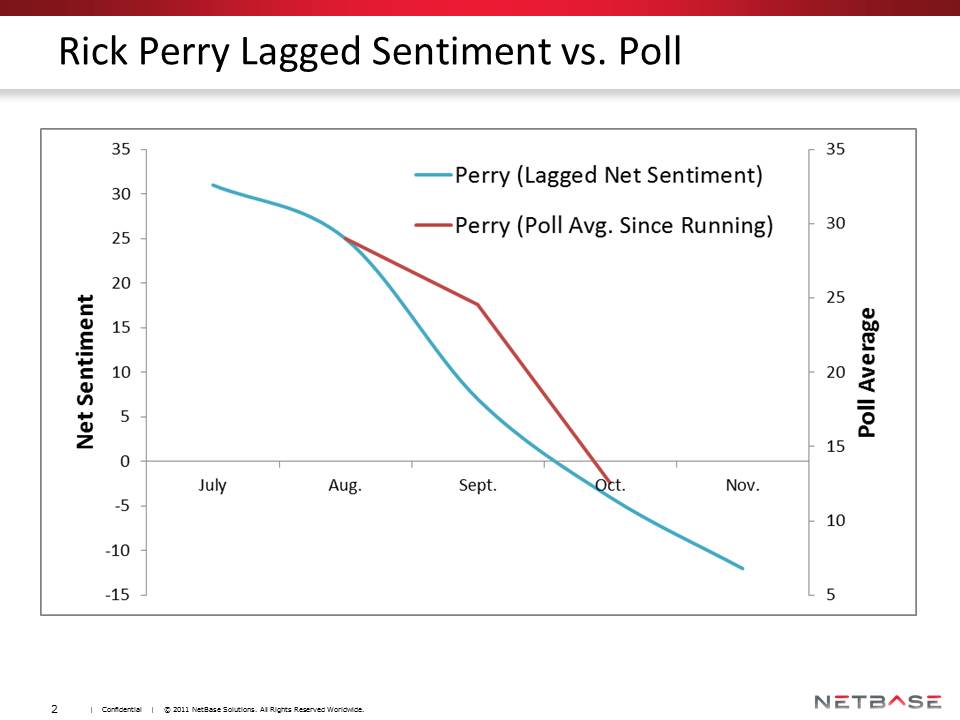
What can we expect from Perry? Well, he isn't making the impression he'd hoped for in the debates and now he is much better known, in a bad way. With his poll position sliding and his large cash position, he seems likely to go to the air. Will he go negative? Given Professor Lovett's research this would suggest some negative advertisements could be in his future plans. But who he should target is less clear. Cain? Romney? Both?

This last picture pretty much sums it up. Perry is heading south rapidly, while Romney is only sliding a little and Cain dropped a lot in his first month in the full public eye. Cain is still the frontrunner on net sentiment, but he and Romney are pretty close on buzz, while Perry's buzz has been decreasing. Perry is the clear winner on passion while Cain is a little weaker and Romney weaker yet.
Adding Obama in the picture, really gives some perspective on all of this data. Though we see differences in the GOP candidates, they are all weaker than Obama on passion and much weaker on buzz. Yet, perhaps more importantly, they are higher than Obama on net sentiment. Is passion more important to the American people than sentiment? If so, Perry might have a chance for a soft landing and a rebound. Of course, that would also suggest whichever Republican is nominated could face a tough struggle against Obama. Stay tuned for more updates.
Subscribe to:
Comments (Atom)